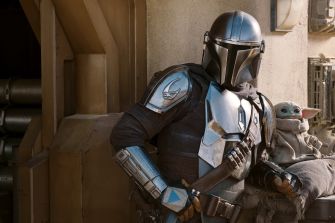
When Star Wars: The Rise of Skywalker arrived in 2019, it closed the Skywalker saga with a divisive response and left the future of Lucasfilm’s flagship franchise looking uncertain. Just a month earlier, however, The Mandalorian had debuted on Disney+, offering what many fans and critics saw as a creative reset. Stripped of the increasingly dense mythology weighing down the films, the series introduced a simpler formula: a lone bounty hunter, a mysterious child, and weekly adventures that leaned more Western than space opera. It became an immediate success, helping define Disney’s streaming ambitions and restoring some goodwill around the brand.
Seven years later, The Mandalorian and Grogu comes back with a different kind of pressure. Directed by Jon Favreau and co-written by Favreau, Lucasfilm chief creative officer Dave Filoni, and Noah Kloor, the film marks Star Wars’ latest attempt to reestablish itself as a theatrical event after years of prioritizing streaming expansion. Instead, the result raises a more uncomfortable question: whether the franchise’s biggest obstacle is no longer audience fatigue with individual projects, but exhaustion with the broader Star Wars content machine itself.
The film opens promisingly. Pedro Pascal returns as Din Djarin, the armored Mandalorian bounty hunter who became the face of Disney’s post-Skywalker Star Wars era, now working in support of the New Republic rather than as a freelance mercenary. The opening action sequence delivers much of what made the original series effective: fast pacing, familiar iconography, practical stakes, and a tone that evokes the original trilogy’s pulpy adventure sensibility without immediately drowning in franchise lore. Grogu remains a commercial and narrative anchor, and the early sequences suggest Lucasfilm may have found a workable transition from streaming episodic storytelling to theatrical spectacle.
The central plot quickly becomes increasingly convoluted, hinging on Din being tasked with tracking an Imperial-linked target whose identity remains unknown, while simultaneously negotiating with members of Jabba the Hutt’s criminal family to retrieve a missing relative. That relative, Rotta the Hutt, reimagined here as an unexpectedly muscular pit fighter voiced by Jeremy Allen White, becomes central to the film’s increasingly chaotic structure. The narrative spends considerable time juggling side missions, betrayals, and criminal double-crosses, but rarely establishes a compelling emotional or dramatic throughline strong enough to justify the film’s theatrical scale.
The larger issue is structural. The Mandalorian and Grogu often feels less like a standalone film than an extended episode arc pulled from a streaming series and expanded for multiplex release. That distinction matters. What worked for The Mandalorian in 2019 was its simplicity and accessibility. The show largely avoided the continuity-heavy burden that had begun to alienate casual audiences. But as Disney expanded its Star Wars television slate with projects including The Book of Boba Fett, Obi-Wan KenobiAhsoka, and Andor, the franchise increasingly adopted an interconnected storytelling model more familiar to Marvel audiences.
That strategy has produced mixed results. Andor earned critical acclaim for its more mature political storytelling, while other projects struggled under the weight of nostalgia-driven callbacks and increasingly fragmented plotting. By the time The Mandalorian reached its third season, viewers were effectively required to have watched multiple adjacent series to fully understand the narrative developments affecting its central characters.
Commercially, the film appears positioned for a respectable opening, but context matters. Star Wars once operated under a different standard. The question was not whether a new release would be profitable, but whether it would define the cinematic conversation. That cultural dominance has eroded. In a marketplace now saturated with franchise storytelling, the burden on Star Wars is no longer simply to exist, but to justify why audiences should experience these stories in theaters rather than wait for the next Disney+ installment.