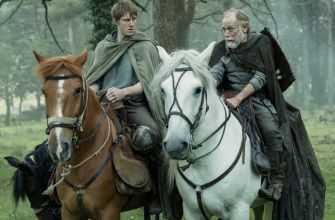
If you tuned into HBO on Jan. 18 (or pressed play on Max shortly thereafter), A Knight of the Seven Kingdoms opened not with a dragon or a palace intrigue, but with a solitary figure digging a grave beneath a bleak, overcast sky. Horses shift nervously as rain falls. A body is lowered into the earth. The man holding the shovel delivers a halting eulogy for his former master, an aging knight who was far from perfect but who nonetheless raised him from childhood.
Then, almost immediately, the show tells you exactly what kind of Game of Thrones spin-off this is not interested in being.
As the young squire, known simply as Dunk, vows to seek adventure and live up to the title of “Ser,” the familiar Thrones theme swells triumphantly. That tonal pivot defines A Knight of the Seven Kingdoms, a six-episode prequel adapted from George R.R. Martin’s Tales of Dunk and Egg novellas, beginning with 1998’s The Hedge Knight. Set roughly a century before the events of Game of Thrones, the series occupies the margins of Westerosi history rather than its blood-soaked center. And unless viewers are deeply familiar with Martin’s extended canon, they could easily miss its franchise connections altogether. The marketing has been understated, especially when compared with the aggressive rollout for House of the Dragon.
In a recent Hollywood Reporter profile, Martin acknowledged that part of the appeal for HBO was the relative affordability of these stories. No massive battles. No sprawling wars. No Red Wedding–scale devastation. The novellas draw less from dynastic history than from medieval folklore and Chaucerian humor.
That’s not to say it lacks significance. Dunk, played with earnest physicality by Peter Claffey, eventually becomes Ser Duncan the Tall, a name that longtime Thrones viewers may recall in passing. His companion, the bald and sharp-tongued Egg (Dexter Sol Ansell), initially presents himself as a stable boy, though his true identity are revealed midway through the season. Still, the series resists treating these connections as narrative fireworks. It’s far more interested in watching these two figures stumble forward together, learning how to survive, negotiate power, and define honor on their own modest terms.
By contrast, A Knight of the Seven Kingdoms recalls what made Westeros compelling in the first place: the texture of everyday life, the friction between ideals and reality. Like Andor did for Star Wars, this series demonstrates that shrinking the scope can deepen the world rather than diminish it.
As the season progresses, each episode builds more confidence: the arrival of the Targaryens introduces political tension without overwhelming the narrative. Dunk’s entanglement with royal authority leads toward a Trial by Seven, a ritual that provides a climactic payoff while honoring the show’s commitment to scale and character.
Perhaps most importantly, A Knight of the Seven Kingdoms restores something the franchise badly needed: anticipation. This is not Game of Thrones as viewers once knew it and that may be precisely why it works.