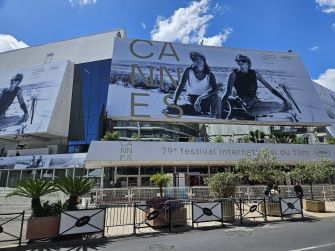
The 2026 Cannes Film Festival closed last week, having delivered a respectable slate of competition titles and a handful of genuine discoveries, but for many of the industry veterans, journalists, and buyers who descended on the Croisette, the dominant impression was one of unusual restraint. Ask anyone how their festival was going, and the answer came back with striking consistency: quiet.
The most readily identifiable cause was the conspicuous withdrawal of American studio cinema. Only two U.S. productions competed for the Palme d'Or, James Gray's "Paper Tiger" and Ira Sachs' "The Man I Love", both received with measured appreciation rather than the excitement a top-tier Hollywood entry tends to generate. Neither took home a prize. The competitive energy that might otherwise have come from across the Atlantic was instead supplied by South Korean filmmaker Na Hong-jin, whose monster film "Hope" delivered the kind of large-scale, genre-driven spectacle that American studios might typically be expected to bring. It was an anomaly that underscored just how absent that particular energy was from the official American contingent.
Festival director Thierry Frémaux acknowledged the imbalance throughout the proceedings, and the numbers bore him out: 17 of the 22 Competition titles were wholly or predominantly European productions, and when the jury handed down its prizes, all eight Competition awards went to European films. Cristian Mungiu's "Fjord" claimed the Palme d'Or, Andrey Zvyagintsev's "Minotaur" took the Grand Prix, and Pawel Pawlikowski's "Fatherland" earned Best Director, a triumvirate that demonstrated European art cinema's continued vitality, even as it reinforced questions about the breadth of the lineup.
American cinema fared somewhat better outside the main competition. Jane Schoenbrun's "Teenage Sex and Death at Camp Miasma," which opened the Un Certain Regard section and went on to win the Queer Palm, was among the festival's more talked-about titles. Jordan Firstman's "Club Kid" set off the most aggressive bidding war of the market, ultimately acquired by A24 for $17 million, a figure that suggested buyers saw commercial potential even in an edition that lacked the marketing machinery of a major blockbuster premiere. A scattering of other American titles populated the official selection, among them new documentary work from Steven Soderbergh and Ron Howard and films headlined by Andy Garcia and John Travolta, but none generated significant traction.
What was entirely missing was the kind of tentpole premiere that has, in banner years, turned Cannes into something approaching a global media event. Steven Spielberg's forthcoming "Disclosure Day" was close enough to release that a Cannes bow was plausible, but the film stayed away. Disney, which in 2018 brought "Solo: A Star Wars Story" to the festival, opted not to debut "The Mandalorian and Grogu" on the Croisette. The calculus behind that kind of decision is not difficult to understand: the festival's concentrated press corps and compressed timeline can be punishing for films that arrive without unanimous support. James Mangold's "Indiana Jones and the Dial of Destiny" learned that lesson in 2023, when lukewarm reviews at Cannes set a difficult tone that lingered for weeks before the film reached general audiences. The festival that gave "Top Gun: Maverick" a genuine prestige boost and helped propel it toward awards consideration, it might not otherwise have received.
Whether Hollywood's absence this year reflects a deliberate risk calculation, a genuine scheduling misalignment, or some combination of both remains unclear. Venice, which has increasingly positioned itself as the preferred launch pad for American awards contenders, may absorb some of that competition in September. And the commercial logic of the festival circuit has always been secondary to the industrial realities of release-date calendars and marketing windows. Paul Thomas Anderson's "One Battle After Another," the eventual Oscar best picture winner, had been penciled in for Cannes before release delays intervened; it ultimately bypassed the festival circuit entirely without any apparent cost to its critical standing or awards trajectory. The episode illustrated something important: Hollywood's prestige output no longer needs Cannes the way it once might have.
What Cannes perhaps needs to grapple with more honestly is what the space left by a diminished American presence revealed about its own programming instincts. A more expansive curatorial vision might have used the opening to bring in films from regions chronically underrepresented in the competition tier. African cinema, in particular, had a case to be made. "Clarissa," from Nigerian filmmakers Arie and Chuko Esiri, a Lagos-set reimagining of "Mrs. Dalloway" starring Sophie Okonedo, was considered by many observers to be competition-caliber work. Marie Clémentine Dusabejambo of Rwanda ultimately won the Camera d'Or for her Un Certain Regard entry "Ben'Imana," a recognition that raised an obvious question about why her film had not been considered for a higher placement. Cannes took exactly that kind of programmatic gamble on Senegalese director Ramata-Toulaye Sy when it placed her debut "Banel and Adama" in competition several years ago. That precedent made the caution this year harder to justify.
The festival did illuminate one of the defining structural realities of contemporary art cinema: the increasing dependence on international co-production. Several of the competition's most admired films found directors working outside their home countries. Ryusuke Hamaguchi's "All of a Sudden" navigated French-Japanese social terrain, Valeska Grisebach's Jury Prize-winning "The Dreamed Adventure" continued her ongoing examination of Bulgarian society, and Radu Jude, in the Directors' Fortnight sidebar, turned his attention to French class dynamics in "Diary of a Chambermaid." The model of national cinema as a self-contained, geographically bounded tradition is increasingly a fiction, and Cannes, to its credit, reflected that reality even while falling short of fully embracing its implications.