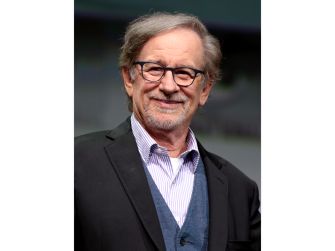
Steven Spielberg has added his voice to a growing chorus of major Hollywood figures pushing back against the encroachment of artificial intelligence into the creative process, saying plainly that while the technology may have legitimate applications elsewhere, he will not allow it to occupy a meaningful role in how he makes films.
Spielberg made the remarks during a recent appearance on "IMO," the podcast hosted by Michelle Obama and Craig Robinson. The conversation covered his broader views on AI's role in society, and while he acknowledged potential value in medical contexts, specifically the technology's capacity to "find solutions to medical issues", he was unambiguous about where he believes it does not belong. "Where I don't love AI is where it takes a position or there's an empty chair at a writer's table," he said. "I'm not willing to substitute, you know, because I don't really believe in sentience. I don't believe there is any substitute for the soul. I don't think that is an algorithm that's inventible."
The director, whose career spans more than five decades and includes films that have fundamentally shaped the grammar of popular cinema, framed his objection in terms that were as philosophical as practical. The idea of a machine claiming emotional intelligence, presenting itself as something that feels, struck him as a violation of the principles that have guided his entire career. "A computer that thinks it feels more than we feel is anathema to the way I was raised and how I'll practice my own trade of producing and directing in the future," he said. It is a distinction that matters to Spielberg not merely as a creative preference but as a kind of professional and personal conviction, one he appears unwilling to negotiate regardless of how capable the technology becomes.
That said, Spielberg stopped short of dismissing AI entirely as a production instrument. He allowed that it could, in time, prove genuinely useful in handling the more logistical dimensions of filmmaking; location scouting was the example he offered, where the work is time-consuming and data-intensive rather than expressive. But the line he drew was firm and specific: AI can be a tool, subordinate to human judgment and human vision, but it cannot be the author of creative decisions. "Don't tell me how to write my dialogue for this character. Don't tell me where the camera has to go. And also don't tell me what the set should look like, unless AI is simply a tool in a large tool chest of the production designer," he said. "Use AI as a tool, but do not use AI as the final word on anything creative. That's where I draw the line."
Spielberg is not alone in drawing it. Leonardo DiCaprio made similar arguments in an interview with Time magazine last December, contending that artificial intelligence is constitutionally incapable of producing authentic art because it lacks the human experience from which art derives its meaning. DiCaprio acknowledged that AI can produce work that is technically impressive, even dazzling. He pointed to AI-generated musical mashups as examples of genuine cleverness but argued that cleverness is not the same thing as art and that, without a human being at the source, any emotional resonance is ultimately hollow. "I think anything that is going to be authentically thought of as art has to come from the human being," he said. The mashups, he noted, get their moment of attention and then "dissipate into the ether of other internet junk. There's no anchoring to it. There's no humanity to it, as brilliant as it is."