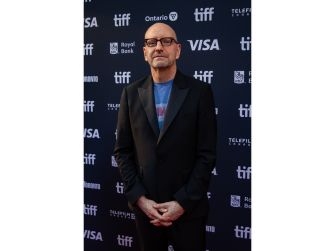
Filmmaker Steven Soderbergh is addressing questions surrounding his decision to incorporate generative artificial intelligence into his upcoming documentary centered on John Lennon, arguing that the technology ultimately served a specific creative purpose rather than replacing traditional filmmaking.
The film, John Lennon: The Last Interview, is built around an audio recording of a conversation Lennon and Yoko Ono gave to RKO Radio on December 8, 1980, the same day Lennon was fatally shot in New York City. Much of the documentary pairs that audio with archival footage and imagery, assembled with the cooperation of Lennon’s estate.
However, Soderbergh said certain portions of the interview, particularly moments where Lennon and Ono reflect on philosophical or abstract ideas, posed a creative challenge. Instead of relying solely on conventional visuals, he turned to AI-generated imagery to illustrate those passages in a more conceptual way.
In a recent interview, the director explained that these sequences make up a relatively small portion of the finished film, estimating them at roughly 10 percent of the total runtime. He described the approach as an attempt to create visuals that are not literal representations of what is being said, but instead function as metaphorical or interpretive extensions of the conversation.
Soderbergh characterized the technique as “thematic surrealism,” emphasizing that the goal was not realism, but rather a visual language that could complement the tone of the audio.
The use of AI in film remains a contentious topic, particularly in creative industries where concerns about authenticity, labor, and ethics have intensified in recent years. Soderbergh acknowledged that reaction, noting that skepticism around the technology is often justified, especially when it is used in ways that could mislead audiences.
According to Soderbergh, the intention was not to recreate Lennon or fabricate lifelike footage, but to use the technology similarly to how filmmakers have long used visual effects or computer-generated imagery. He distinguished deceptive applications of AI and the way it was employed in his documentary.
He pointed to specific examples from the film to illustrate that distinction. In one sequence, AI-generated imagery depicts infants dressed in 1960s-style clothing, crying as a humorous visual interpretation of a topic Lennon discusses. In another, cavemen are shown acting out behaviors referenced in the interview, offering a satirical lens on the themes being explored.
Soderbergh argued that attempting to stage those scenes practically would either be impractical or fail to achieve the same effect. More importantly, he suggested that part of the humor comes from the audience recognizing that the images are artificial.
The director also addressed speculation that the film might use AI to digitally recreate Lennon himself, an idea he rejected outright. He said such assumptions misunderstand both his intent and the tone of the project, emphasizing that the documentary remains grounded in real archival material.
Transparency, he added, was central to his approach. Rather than obscuring the use of AI, Soderbergh said he believes filmmakers have a responsibility to clearly communicate how such tools are being used, particularly as the technology becomes more widespread.
The project also involved collaboration with Meta, which provided access to generative video tools as well as financial support. Soderbergh noted that the partnership came about late in the production process, after the film had largely been assembled. Meta’s involvement allowed the team to experiment with sequences that would have been difficult or impossible to produce through conventional means.
John Lennon: The Last Interview has not yet announced a wide release date.