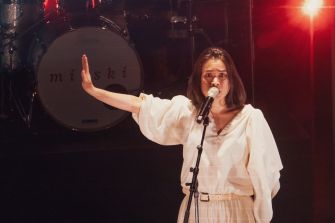
When Mitski concludes her five-night residency at Hollywood High School, the run will stand out as a rare example of a major contemporary artist choosing a secondary-school auditorium over a traditional concert venue. The decision places her within a limited lineage of performers, including Elvis Costello and Morrissey, who have staged similarly scaled shows at the historic Los Angeles campus.
While the residency is unusual in format, it is consistent with Hollywood High’s longstanding association with the entertainment industry. Established more than a century ago, the school has produced a wide range of figures in film, television, and music. Its alumni include Judy Garland, Lana Turner, and numerous other performers whose careers helped shape Hollywood’s 20th-century identity. The campus itself reflects that legacy, with hallways, archival materials, and a small museum documenting its historical ties to the industry.
Principal Samuel Dovlatian has framed Mitski’s residency as both a tribute to that history and an opportunity to reintroduce the school as a contemporary cultural space. The auditorium, seating approximately 1,900, retains many of its original architectural features, including a traditional proscenium stage and fixed seating. These characteristics, while limiting from a production standpoint, contribute to the venue’s appeal as a setting that feels distinct from modern theaters.
For Mitski, the residency aligns with a broader shift in how she has approached live performance in recent years. Following larger-scale shows in Los Angeles, including multi-night runs at venues such as the Shrine Auditorium and the Hollywood Bowl, the move to a smaller space reflects an interest in reducing the distance between performer and audience. In interviews, she has described a desire to recreate the atmosphere of early performances, settings defined less by production scale and more by direct engagement.
That intention shaped both the logistics and the experience of the Hollywood High shows. Tickets were distributed through a lottery system, with additional seats allocated to students based on attendance criteria. The result was an audience composed largely of younger fans, alongside members of the general public who secured limited availability. For many attendees, the residency offered access to a performance environment that would be difficult to replicate in larger venues.
The setting itself also influenced the tone of the performances. Mitski has acknowledged that returning to a high school environment can evoke a range of emotional responses, including discomfort and heightened self-awareness. Rather than avoiding those associations, the residency appears to incorporate them into the broader experience, using the familiarity of the space as a framework for the music.
From an operational standpoint, hosting a residency of this scale required significant adaptation. The school’s auditorium is not designed for high-capacity touring productions, meaning that sound, lighting, and staging infrastructure had to be installed specifically for the engagement. According to sources familiar with the production, much of the equipment was brought in externally, effectively transforming the space into a temporary concert venue.
The residency was scheduled during the school’s spring break to avoid disrupting academic activities. Outside of the performances, Hollywood High continues to function as an active educational institution, with programs in performing arts, media production, and other disciplines connected to the entertainment industry. Facilities include a production studio equipped with professional-grade cameras and editing systems, as well as partnerships with industry professionals who contribute to student training.