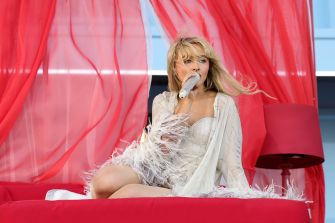
Sabrina Carpenter made her Coachella headlining debut with a tightly produced, visually driven performance that emphasized stagecraft as much as music. The set leaned into a Hollywood-inspired aesthetic, combining pre-recorded visuals, choreography, and narrative interludes to frame her catalog within a broader concept.
The show opened with a filmed sequence featuring Carpenter driving through a desert landscape, where she encounters a younger version of herself. Sam Elliott appears in the segment as a police officer delivering a vague warning, establishing a tone that carried into the live performance. Once on stage, the production shifted into a stylized version of Los Angeles iconography, with retro cars, hillside backdrops, and illuminated signage spelling out “SABRINAWOOD.”
Carpenter structured the set to prioritize her most recognizable material early. Several of her biggest songs appeared within the opening portion of the performance, generating immediate audience engagement. Her vocal delivery remained consistent throughout, even during physically demanding choreography, including sequences that required continuous movement across the stage.
A notable moment came with the live debut of “We Almost Broke Up Again Last Night,” which contrasted the high-energy opening with a more restrained, emotionally focused performance. Elsewhere, songs like “Manchild” incorporated comedic staging, with dancers in exaggerated costumes adding a layer of visual irony.
The performance lost some momentum in its middle section. A prolonged spoken-word interlude featuring Susan Sarandon, portraying an older version of Carpenter, interrupted the pacing. The segment, which functioned as a reflective monologue, was followed by several slower songs, extending the lull.
Additional cameo appearances, including Will Ferrell in a brief comedic role, reinforced the show’s theatrical framing but did little to maintain the earlier energy. The sequence appeared designed to support costume changes and set transitions, though it came at the expense of continuity.
The latter portion of the set returned to a more consistent rhythm. Songs like “Feather” reintroduced stronger choreography and visual cohesion, while a voiceover cameo from Samuel L. Jackson added another cinematic element without significantly disrupting the flow.
Carpenter closed the performance with her most commercially successful tracks, supported by large-scale staging and ensemble choreography. The finale incorporated confetti effects and a return to the visual motifs introduced at the beginning of the show, bringing the production full circle.
Carpenter’s headlining set reflected a clear emphasis on control and presentation. Rather than relying on guest performers, she centered the show entirely on her own material and stage identity. The decision aligned with a broader trend among pop headliners toward self-contained, concept-driven performances.
While the mid-set pacing issues highlighted the risks of heavy narrative integration, the overall production demonstrated a level of planning and scale consistent with a major festival headliner. The performance ultimately underscored Carpenter’s transition from rising pop act to a performer capable of carrying a large-stage production on her own terms.