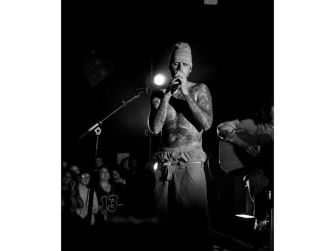
Justin Bieber closed out Saturday night at Coachella with a performance that deliberately avoided the large-scale production typical of festival headliners, opting instead for a minimal, loosely structured set centered on his recent material.
The show, which ran for roughly 90 minutes, contrasted sharply with the more elaborate staging seen elsewhere on the lineup. Bieber opened with a sequence of songs from his recent Swag projects, performing largely alone on a sparsely designed stage. For much of the early portion, he remained physically subdued, dressed in a hooded sweatshirt and avoiding the kind of visual spectacle or choreography often associated with his past tours.
The setlist was initially dominated by newer songs, with little reference to Bieber’s earlier catalog. His vocal performance remained consistent throughout, but the restrained staging and pacing drew mixed reactions from both the live audience and viewers watching the festival livestream.
The production appeared intentionally scaled back, with minimal lighting changes and limited use of additional performers. At times, the presentation resembled a rehearsal or studio session more than a traditional festival headline show.
The tone of the performance began to shift roughly halfway through, when The Kid Laroi joined Bieber onstage for “Stay,” providing the first major change in energy. Shortly after, Bieber moved to a secondary stage area for an acoustic segment accompanied by two guitarists, marking a transition toward a more collaborative and relaxed atmosphere.
This portion of the set extended the show’s intimate tone, though it continued to prioritize mood over momentum.
The most unusual part of the performance came during an extended interlude in which Bieber used a laptop onstage to search for and play archival videos of his earlier work. The segment functioned as an improvised retrospective, with Bieber occasionally singing along to clips of songs such as “Baby,” as well as earlier covers that first gained traction online.
The sequence also included non-musical footage, including personal and viral moments from his early career. While unconventional, the segment provided the only substantial engagement with his pre-Swag catalog, effectively substituting for a more traditional greatest-hits section.
Additional guests appeared late in the set, including Tems and Wizkid for “Essence,” as well as Mk.gee, who contributed live guitar to the closing performance of “Daisies.”
These appearances shifted the performance toward a more communal dynamic, contrasting with the largely solo first half. The show concluded without a traditional encore or major production finale, maintaining the understated approach that defined the set overall.
Audience response to the performance was divided. Some viewers criticized the lack of production and pacing, while others responded positively to the informal, introspective tone. The livestream’s comment sections reflected this split, with reactions ranging from frustration to appreciation for the show’s stripped-down format.
The performance did not follow the structure of a conventional festival headline set, nor did it attempt a career-spanning retrospective. Instead, Bieber presented a more personal and loosely curated experience, prioritizing recent material and spontaneous elements over spectacle.
The set raises questions about how Bieber may approach future live performances, particularly if he returns to touring after several years away from large-scale shows. The minimal production and emphasis on atmosphere suggest a potential shift away from the highly choreographed formats that defined earlier phases of his career.