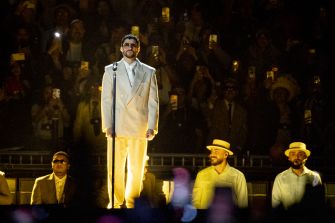
At the height of his global popularity, Bad Bunny made a decision that ran counter to industry convention. Rather than mounting a traditional North American stadium tour, the Puerto Rican artist centered his home island with a 31-date residency in San Juan, a move that would become one of the most economically and culturally consequential live-music events in the territory’s modern history.
The residency, titled No Me Quiero Ir de Aquí (“I Don’t Want to Leave Here”), took place at the José Miguel Agrelot Coliseum, known locally as El Choli, beginning July 11, 2025. Spread across Friday, Saturday, and Sunday nights, the sold-out run drew more than half a million attendees. The first nine shows were reserved exclusively for Puerto Rico residents, while the remaining 21 encouraged international visitors to travel to the island.
Multiple studies have attempted to quantify the residency’s economic impact, though estimates vary depending on methodology. Indira Luciano Montalvo, an associate professor of economics at the University of Puerto Rico–Río Piedras, conducted what she describes as a “very conservative” assessment focused on measurable economic activity tied directly to the event. Her study estimates a minimum impact of $176.6 million, largely derived from wages, employment, and tax revenue.
Tourism-focused analyses offer higher figures. Discover Puerto Rico, the island’s destination marketing organization, estimates approximately $200 million in visitor spending related to lodging, transportation, and food. A separate report from consulting firm Gaither International places the total impact closer to $733 million, factoring in international exposure and longer-term shifts in global perception of Puerto Rico.
Beyond direct financial metrics, economists and cultural leaders emphasize that the residency’s most significant effects may be those that are hardest to quantify.
“There is the measurable economic impact,” says Javier Hernández Acosta, dean of the School of Arts, Design, and Creative Industries at Universidad del Sagrado Corazón. “But more important is how this event touched different layers of the economy and culture simultaneously.”
One clear beneficiary has been Puerto Rican musicians who shared the stage with Bad Bunny throughout the residency. The group Chuwi, which performed at all 31 shows, has since joined the Latin American leg of Bad Bunny’s world tour. Before they collaborated on DeBÍ TiRAR MáS FOToS, Chuwi had a modest following; after the album’s release, their monthly Spotify listeners surged to over 14 million.
Another nightly presence at the residency was Los Pleneros de la Cresta, a plena collective founded in 2013 with the goal of preserving Afro-Puerto Rican musical traditions. Their collaboration with Bad Bunny transformed their trajectory. After appearing on the track “CAFé CON RON,” the group’s monthly listeners grew from tens of thousands to 12 million, fundamentally altering their economic stability and cultural reach.
“This is a chain,” says Joseph Ocasio Rivera of Los Pleneros. “Economic stability allows us to reinvest in our communities and cultural projects.”
Similar ripple effects extended to fashion, transportation, and service industries. Local designers gained new clients, taxi drivers reported record earnings, and artisans saw dramatic spikes in sales. Discover Puerto Rico notes that businesses outside traditional tourist corridors, such as neighborhood cafés, independent vendors, and local shuttle operators, experienced sustained growth.
The residency also reshaped seasonal tourism patterns, transforming what is typically the slow hurricane season into a period of elevated activity. More significantly, Pérez of Discover Puerto Rico says the event repositioned the island globally.
“Puerto Rico is no longer perceived only as a beach destination,” she explains. “It is increasingly recognized as a cultural capital.”