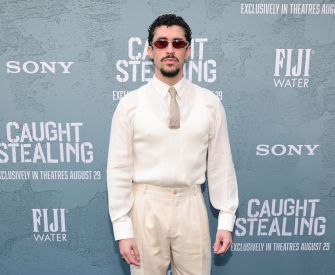
Bad Bunny has spent the better part of the past decade redefining what global pop stardom looks like for a Spanish-language artist. This Sunday, that trajectory reaches a new milestone when he becomes the first Latino male artist to headline the Super Bowl halftime show and the first headliner to perform primarily in Spanish.
The performance arrives just days after Bad Bunny’s landmark Grammy win for Album of the Year, which made DeBí TiRaR MáS FOToS the first fully Spanish-language album to take the Recording Academy’s top prize. Together, the moments mark a broader shift in how Latin music is positioned at the highest levels of American pop culture.
While the NFL, Roc Nation, and Apple Music, the partners behind the halftime show, rarely offer detailed insight into their selection process, executives involved in the production frame Bad Bunny’s booking as a reflection of cultural reality rather than a calculated risk.
“Bad Bunny isn’t just one of the biggest artists in the world, he’s one of the most culturally influential,” said Jon Barker, the NFL’s senior vice president of global event operations and production, in an interview with Rolling Stone. “He represents where music is right now: global, genreless, and driven by authenticity.”
Roc Nation CEO Desiree Perez echoed that sentiment, calling Bad Bunny “the perfect artist” for this year’s show. Over the past several years, the Puerto Rican star has achieved a string of industry milestones: four consecutive all-Spanish albums topping the Billboard 200, the most-streamed album in Spotify history with Un Verano Sin Ti, and record-setting livestreams and tour numbers across multiple platforms.
Though rumors circulated that other artists, including Taylor Swift and Post Malone, were discussed internally, Apple Music executive Oliver Schusser emphasized that halftime show conversations typically unfold over long periods. “We’re always talking with Roc Nation about a short list of artists,” he said. “At the end of the day, they made the decision, and we were thrilled.”
Bad Bunny’s relationship with Apple Music dates back to his earliest days. In 2016, Latin music programmer Jerry Pullés became one of the first curators to formally support his music on a major DSP, adding him to Apple Music’s early Latin trap playlists before he had measurable streaming traction. That early bet, Pullés says, now feels “full circle.”
The historic nature of the performance has not gone without backlash. Conservative commentators and advocacy groups have criticized the decision to spotlight a Spanish-language set on the Super Bowl’s biggest stage, with some framing it as political. Bad Bunny has largely avoided direct engagement, aside from a brief satirical reference during a recent Saturday Night Live appearance.
Official details about Sunday’s performance remain closely guarded. A teaser released in January, featuring dancers gathered beneath a flamboyán tree, hinted at themes of community and unity. Marissa Lopez, Apple Music’s head of Latin artist relations, described the set atmosphere as collaborative and celebratory. “Unity is central to how Benito approaches his work,” Lopez said. “That’s always been part of his message.”