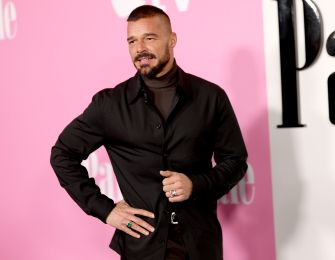
Ricky Martin has publicly celebrated Bad Bunny following the artist’s historic night at the Grammy Awards, publishing an open letter in Puerto Rico’s leading newspaper, El Nuevo Día.
The letter arrived after Bad Bunny won three Grammy Awards on Sunday, including Album of the Year for DeBí TiRaR MáS FOToS, marking the first time the Recording Academy’s top honor has gone to an album performed entirely in Spanish. Martin framed the achievement not only as a personal victory for Bad Bunny, born Benito Martínez Ocasio, but as a milestone for Puerto Rican culture and Spanish-language music at large.
Titled “When One of Ours Succeeds, We All Succeed,” the letter reflects Martin’s own experience navigating global stardom while maintaining cultural identity. Writing in Spanish, Martin described being moved by watching Bad Bunny accept the awards without compromising his language, accent, or worldview. He emphasized that success at that level often comes with pressure to assimilate, a pressure Bad Bunny has consistently resisted.
“I know what it means to succeed without letting go of where you come from,” Martin wrote, noting the personal and professional costs that can accompany that choice. He characterized Bad Bunny’s Grammy win as more than a musical accomplishment, calling it a cultural and human victory that affirmed authenticity as a viable path to global recognition.
Martin highlighted the significance of Bad Bunny’s refusal to dilute his Spanish or obscure his Puerto Rican identity in pursuit of broader appeal. According to Martin, that commitment has redefined expectations within the global music industry and expanded possibilities for artists working outside the English-language mainstream.
He also referenced Bad Bunny’s acceptance speech, which addressed immigration, displacement, and systemic inequality, themes Martin said resonated deeply with communities living between borders and languages. Martin described the moment as striking not only for what was said, but for the silence in the room as the audience listened.
“What moved me most was seeing an entire audience stop to listen,” Martin wrote, pointing to Bad Bunny’s willingness to use a global platform to acknowledge immigrant experiences and political realities often sidelined in entertainment spaces.
The letter also contextualized the Grammy win within a broader moment in Bad Bunny’s career. This Sunday, the artist is set to headline the Super Bowl halftime show, the first time a performance led entirely in Spanish will anchor the event. In promotional material for the show, Bad Bunny promised, “The world will dance,” signaling another high-profile opportunity to foreground Latin culture on a global stage.
Martin concluded his message by underscoring the broader impact of Bad Bunny’s success, particularly for younger generations. He framed the achievement as evidence that cultural identity is not an obstacle to success, but a foundation for it.
“This achievement belongs to a generation that learned from you that identity is non-negotiable,” Martin wrote. “From one Boricua to another, with respect and gratitude.”
Bad Bunny now counts 16 Grammy nominations across his career, with three wins. DeBí TiRaR MáS FOToS earned six nominations this year, making him the first Spanish-language artist to be nominated for Album, Record, and Song of the Year in the same Grammy cycle.