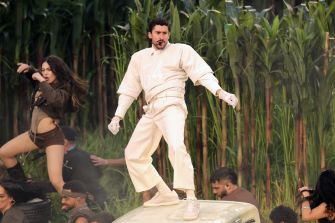
Bad Bunny made history at Super Bowl LX with a halftime performance that foregrounded Puerto Rican culture and Spanish-language music on one of the most visible stages in global entertainment. The set marked the first time a Latin artist delivered a Super Bowl halftime show primarily in Spanish, a milestone that reflected both the artist’s international reach and the NFL’s evolving approach to its marquee spectacle.
The performance opened with “Tití Me Preguntó,” as Bad Bunny moved through a carefully constructed set designed to evoke everyday scenes from Puerto Rico. Dancers wore traditional pava hats, while men played dominoes at tables, a nod to communal rituals deeply embedded in Puerto Rican social life. Rather than relying on abstract visuals, the staging leaned heavily into cultural specificity, positioning the show as both celebratory and declarative.
From there, Bad Bunny transitioned into “Yo Perreo Sola,” accompanied by a large ensemble of dancers that filled the field with tightly choreographed movement. A focal point of the set was La Casita, the pink traditional Puerto Rican house that has become a recurring element in Bad Bunny’s live performances. Elevated above the stage, the structure served as both a visual anchor and a gathering space. During the Super Bowl show, La Casita featured celebrity guests including Jessica Alba, Karol G, and Pedro Pascal, reinforcing the performance’s sense of community and shared cultural presence.
The evening’s most unexpected moment arrived midway through the set, when Lady Gaga emerged to join Bad Bunny onstage. The two performed a salsa-inflected version of “Die With a Smile,” backed by Los Pleneros de la Cresta, Bad Bunny’s longtime collaborators known for blending traditional Afro-Puerto Rican rhythms with contemporary arrangements. The collaboration then transitioned into Gaga’s salsa hit “BAILE INoLVIDABLE,” marking one of the more stylistically adventurous cross-genre moments in recent Super Bowl history.
Bad Bunny continued with a run of songs including “NUEVAYol”, “LO QUE LE PASÓ A HAWAii”, “El Apagón”, and “CAFé CON RON,” weaving together themes of migration, political awareness, and cultural pride. For the finale, he closed with “DtMf,” punctuated by an expansive fireworks display that lit up the stadium.
Throughout the performance, Bad Bunny addressed the crowd directly, offering a “God bless America” before naming every country in the Americas, reaffirming his Puerto Rican identity and reminding the audience that “America” is an entire continent. Though born and raised in Puerto Rico, Bad Bunny is a U.S. citizen, a fact that became central to the broader conversation surrounding the show.
The halftime performance arrived amid heightened political scrutiny. In the weeks leading up to the Super Bowl, right-wing commentators criticized the NFL’s choice, branding the performance “un-American.” Conservative group Turning Point USA organized an unofficial “alternative halftime” event featuring Kid Rock, while former President Donald Trump publicly dismissed the selection, stating he did not know who Bad Bunny was and calling the decision “ridiculous.”
Bad Bunny largely avoided engaging with the controversy. Speaking at a press conference prior to the game, he said his focus remained squarely on celebrating Puerto Rican culture. “I want to bring to the stage a lot of my culture,” he said, adding that the performance was intended to be joyful rather than polemical. “It’s going to be fun, and it’s going to be a party. People only have to worry about dance.”
While Bad Bunny previously appeared during the Super Bowl halftime show in 2020, joining Jennifer Lopez and Shakira for “I Like It,” this marked his first time headlining the event.