Pixar's fifth installment in its flagship franchise doesn't arrive in theaters until June 19, but the studio has been offering carefully rationed previews and what has emerged so far suggests a film more interested in sitting with discomfort than resolving it neatly. At a press screening in Anaheim last month, directors Andrew Stanton and McKenna Harris, alongside producer Lindsay Collins and key members of the production team, walked journalists through the opening 30 minutes of the film and spoke at length about the choices: narrative, technological and philosophical that shaped this latest chapter.
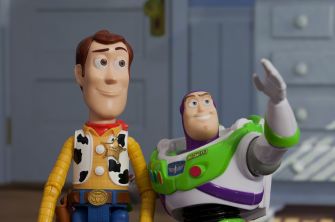
The most immediately striking of those choices involves Woody. The pull-string cowboy, again voiced by Tom Hanks, returns visibly changed: he's heavier, wearing a red poncho over his trademark shirt and jeans, and when he removes his hat, the bald spot is unmistakable. The detail is played for a kind of wry affection rather than pathos. Stanton explained that Woody, now several years into the life he chose at the end of the fourth film, has simply stopped looking after himself with the same vigilance that once defined him. "He has a new purpose of not being devoted to one kid. He's out in the field and not worrying," Stanton said. The bald spot, he continued, was meant to signal exactly that, a toy who has been doing unglamorous, unwitnessed work and couldn't care less about his appearance. The idea surfaced during a gag session about what aging might look like for toys. Harris noted that an even more extreme version was floated at one point. "We wanted to make him insanely sun-bleached, but that didn't make it," she said.
The more substantive provocation of the film, however, is Lilypad, a tablet-like device voiced by Greta Lee, whose arrival in Bonnie's life reshapes the dynamic among all the toys. Bonnie is now eight years old, and her world, like that of most children her age, is heavily mediated through screens. She and her friends communicate via group chats and online games, and Lilypad sits at the center of that ecosystem. The toys, led in this installment by Jessie, are forced to confront what this means for them and whether they are facing something like obsolescence. For all of that, Stanton was emphatic that Lilypad is not a villain, even if the toys experience her as a threat. "She is to the toys because they're understandably intimidated," he said. "She's just the next phase in Bonnie's life. She's built like a toy in the sense that she wants to help the kid go forward, but she's got very different skills and zero experience, whereas Jessie has nothing but experience and is probably unprepared for what to do."
The decision not to make Lilypad a straightforward antagonist was contested internally. Harris acknowledged the difficulty of that creative argument. "Lots of people at the studio wanted her to be a villain, and it was so hard to strike the balance because I think we all come in with such loaded emotions towards devices. At the end of the day, it never made sense." The filmmakers kept returning to a simple observation about real life: devices are not going away, and pretending otherwise would have undermined everything the story was trying to say. "We're not getting rid of these devices, no matter how hard we try," Harris said. "I'm always going to have my phone. I'm probably going to be partially addicted to it. So it felt right for the toys to have to grapple with that nuance." Finding a voice that could carry that ambiguity without alienating the audience was its own challenge. Collins described the casting brief for Lilypad as contradictory almost by design: "She's got to be not likable, but also warm and appealing." Lee, she said, threaded that needle precisely. "The voice needed to not cross into 'Oh, I don't like her. I don't want to listen to her anymore.'"
If Lilypad represents the film's thematic core, Jessie is its emotional engine. The fifth film marks a significant shift in her status within the franchise, she is front and center in a way she has never been before. The story sends her back to Emily's former home, the place that haunts her from the flashback sequence in "Toy Story 2." Emily no longer lives there; a new family has moved in, including a young girl named Blaze, voiced by Mykal-Michelle Harris. Stanton, who was approached to write the film more than five years ago, said he initially wasn't sure he was interested. He agreed to go away and develop something only on the condition that he could come back with material he would genuinely want to see as a fan. Several ideas proved durable enough to survive into the final film: Jessie's unfinished emotional business, the presence of screens as a destabilizing force in toy life, and for purely aesthetic reasons, 50 Buzz Lightyear toys washing ashore. When Harris joined the project, additional strands came into focus, including the return to the old address and the question of what it means for a toy to confront abandonment a second time.
The introduction of Blaze also gave Pixar a technical problem to solve. Animator and lead character designer Matt Nolte and VFX supervisor Thomas Jordan oversaw the development of a new hair system capable of rendering and animating fine-detail curls with physical accuracy, each curl programmed to respond to the others, as well as to Blaze's shoulders and clothing. Harris was clear that authenticity was not negotiable. "We had Black colleagues at the studio who kept us honest to whether or not her hair was feeling the way it would feel, especially when it came to scenes you might not see of her waking up early in the morning, and what might those curls look like." Jordan confirmed the system will extend beyond this film: future Pixar productions will be able to draw on it to depict a wider range of hairstyles. It is, by any measure, an overdue advancement.
The new tech toys - Smarty Pants, Atlas and Snappy, were conceived as a generation older than Lilypad, deliberately dated in a way that distinguishes them from the tablet's sleek modernity. Smarty Pants, voiced by Conan O'Brien, was designed to assist with potty training and draws visual inspiration from a toilet paper roll, complete with a low-resolution LCD screen. Production designer Bob Pauley explained the thinking: "With Smarty Pants, Bonnie would have had that potty training device when she was two or three, and that device could have been made five or eight years before that." The nostalgia built into its design means it poses no competitive threat to Lilypad, it exists in a different register entirely. The casting of O'Brien led directly to the rest of the tech trio: Craig Robinson as Atlas, a hippo-shaped geocaching toy, and Shelby Rabara as Snappy, an older digital camera. Stanton wanted the three voices to be sonically distinct enough that audiences could track them easily when speaking in concert.
Animating Lilypad herself required a split workflow. Jordan described a process in which the animation of her physical form, her face, hands, feet and body, was handled through traditional methods, while her screen was animated entirely separately by a different team. During production, the screen was simply blacked out, leaving the primary animators to mime their way through what they imagined might be happening on it. Pauley's team gave them a virtual pencil to sketch rough ideas directly onto the screen during pitches, but the final graphics were completed in a subsequent pass by a separate group.
Randy Newman returns to score the film, as he has for every installment. Stanton, who described himself as firmly "Team Randy," said Newman's combination of romanticism and skepticism remains the right key for this material. Collins offered a tease: Newman gets to "go really big" this time, with extended Western cues tied to Jessie's storyline.
On the subject of artificial intelligence, both Stanton and Harris were direct. Stanton acknowledged that machine learning has been part of Pixar's toolkit since the studio's early days, but drew a clear line between tools that help artists work and tools that replace them. "I have no interest in doing anything but working smarter, faster with another artist," he said. Harris put it in terms of what's visible on screen. "Pixar is a technology company first, and so things are changing. But as far as our process on 'Toy Story 5' went, what you're seeing on screen is the work of a lot of awesome artists."