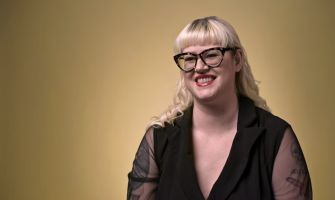
More than two decades after her appearance on America’s Next Top Model, Shandi Sullivan is speaking publicly about the experience that once defined her in the public eye and the episode that turned one of the most painful nights of her life into national television.
When Sullivan auditioned for the reality competition series in 2004, she was a 19-year-old working at a Walgreens in Kansas City, Missouri. Asked why she wanted to become America’s next top model, she responded impulsively: “I don’t want to work at Walgreens anymore!” Within weeks, she had secured a spot on the show’s second season, then a rising ratings powerhouse hosted by Tyra Banks.
At the time, ANTM was cementing itself as a cultural force, blending fashion industry aspirations with reality television drama. But a new Netflix docuseries, Reality Check: Inside America’s Next Top Model, revisits the franchise with a more critical lens, examining both its impact and its alleged harm. Among the former contestants featured is Sullivan, whose storyline became one of the most memorable (and controversial) in the show’s early years.
Sullivan advanced to the final four, traveling to Milan for the competition’s international leg. During that trip, producers invited male models back to the contestants’ house after a day of filming. Sullivan recalls the gathering as initially framed as a low-key opportunity to decompress after weeks of intense competition.
Instead, she says, the situation escalated.
Sullivan describes being heavily intoxicated after consuming significant amounts of alcohol while exhausted and underfed. She says she blacked out and remembers only fragments of the night: entering a hot tub at producers’ encouragement, kissing one of the men, flashes of being pulled from a shower floor, and waking up in distress the next morning.
The male model involved was never publicly identified and was not charged with any crime. Sullivan did not report the incident at the time. What followed, however, was broadcast to millions of viewers.
Cameras captured her sobbing and a tearful phone call to her boyfriend back home. The episode was framed primarily as a storyline about infidelity. In a subsequent reunion episode, Sullivan says producers replayed the footage despite her request that they not do so. “My whole feeling for a long time was, I did this. I let this happen”, Sullivan says now. “But there were people watching the whole time. Someone could have stepped in. Someone could have said, ‘We need to put the cameras down.’”
In the Netflix docuseries, executive producer Ken Mok defends the show’s approach, describing Top Model as a documentary-style production with cameras present around the clock. He characterizes the incident as one of the series most memorable moments. Tyra Banks, in the documentary, states that production decisions were not within her purview.
For Sullivan, the deeper wound lies not only in what occurred that night, but in how it was edited and presented. She says the focus on “cheating” overshadowed the broader context of intoxication, vulnerability, and the power imbalance inherent in a highly produced reality environment: “If you see somebody that’s blackout drunk, and you see a guy messing with her, you could step in,” she says. “It never had to get to that point.”
Now 43, Sullivan says she has spent years untangling guilt from accountability. Revisiting the experience for the documentary was emotionally taxing. “My body still feels that trauma,” she says. “My skin crawls when I talk about it.”
She has no plans to watch the series herself. Instead, she says she is focused on building a life far removed from the modeling industry. While Sullivan does not describe herself as seeking retribution, she acknowledges that an apology from those at the helm of the show would matter. “It is about respect.”