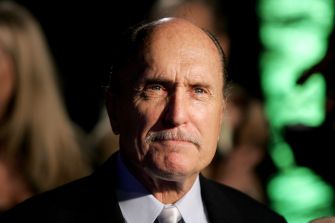
Robert Duvall, the Oscar-winning actor whose flinty intensity and unvarnished realism helped define American cinema in the 1970s and beyond, died Sunday at the age of 95.
His wife, Luciana Pedraza Duvall, confirmed the news in a statement shared on the actor’s official social media accounts, saying he “passed away peacefully at home, surrounded by love and comfort.” A cause of death was not disclosed.
“To the world, he was an Academy Award-winning actor, a director, a storyteller,” she wrote. “To me, he was simply everything.”
Over a career that spanned more than six decades, Duvall became one of the essential figures of the New Hollywood movement, lending gravity and moral complexity to films that reshaped American storytelling. He worked with a generation of transformative directors, including Francis Ford Coppola, Robert Altman, and George Lucas, and built a reputation as an actor who valued emotional truth over theatrics.
Born Robert Selden Duvall on January 5, 1931, in San Diego and raised in a military family, he moved frequently during his childhood. After serving in the U.S. Army, he studied acting in New York, where he formed friendships with future stars like Dustin Hoffman and Gene Hackman.
Duvall’s film debut came in 1962 with his understated portrayal of Boo Radley in To Kill a Mockingbird. The performance, largely silent yet emotionally resonant, hinted at the restraint that would become his signature.
Throughout the 1960s, he worked steadily in supporting roles before breaking through as Major Frank Burns in Altman’s irreverent antiwar comedy M*A*S*H. But it was the following year that would alter his trajectory.
In 1972, Duvall appeared as Tom Hagen in The Godfather, earning his first Academy Award nomination. He reunited with Coppola for Apocalypse Now, earning another Oscar nomination for his portrayal of Lt. Col. Bill Kilgore, the cavalry officer whose casual bravado masked the absurd brutality of war. The line “I love the smell of napalm in the morning” became one of the most quoted in American cinema.
Duvall would later say he reshaped the role to avoid caricature, drawing from his own military experience to ground the character in authenticity.
In 1983, Duvall won the Academy Award for Best Actor for his role in Tender Mercies, playing Mac Sledge, a washed-up country singer seeking redemption. The performance remains one of the most admired of his career.
He received additional nominations for The Great Santini, A Civil Action, and The Judge, cementing his reputation as one of Hollywood’s most reliable and fearless performers.
Duvall also directed and starred in The Apostle, a spiritually complex drama he wrote and financed himself. The film earned him another Best Actor nomination and is widely regarded as one of his most personal works.
Known for his blunt honesty, Duvall often challenged directors and resisted roles he felt lacked depth. He famously declined to appear in The Godfather: Part III, citing dissatisfaction with contract terms. He was outspoken about acting styles and filmmaking approaches, never hesitating to defend his view of performance as disciplined “play-acting.”
Yet colleagues consistently praised his generosity and mentorship. In later years, younger filmmakers such as James Gray and Steve McQueen sought him out, recognizing his connection to an era of American cinema defined by creative risk and psychological nuance.
His portrayal of Augustus “Gus” McCrae in the 1989 miniseries Lonesome Dove earned him an Emmy Award and introduced him to a new generation of viewers.
Duvall collected one Oscar, one Emmy, a BAFTA, and three Independent Spirit Awards over his lifetime. But accolades never seemed to define him. He often described acting as a disciplined extension of self rather than a transformation.
His death marks the passing of one of the last towering figures of New Hollywood, a generation of actors who reshaped American film with grit and emotional intelligence.