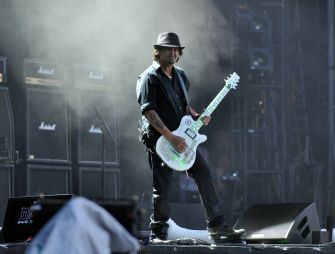
Phil Campbell, the longtime guitarist of Motörhead and a central figure in the band’s later era, has died at the age of 64. His death was confirmed Saturday through a statement shared on the official social media pages of his later band, Phil Campbell and the Bastard Sons.
According to the statement, Campbell died peacefully following complications after a major operation. His family described him not only as a respected musician but as a devoted family man. “Phil was a devoted husband, a wonderful father, and a proud and loving grandfather,” the statement said. “He was deeply loved by everyone who knew him and will be greatly missed.”
Born in Wales, Campbell first became known in the late 1970s as a member of the heavy metal band Persian Risk, where he spent several years building his reputation as a guitarist. His career took a decisive turn in 1984 when Motörhead founder and frontman Lemmy Kilmister recruited him following the departure of guitarist Brian Robertson.
Campbell made his first appearance with the band on the 1986 album Orgasmatron. He would go on to become the longest-serving guitarist in Motörhead’s history, remaining with the band for 31 years until its dissolution following Lemmy’s death in 2015.
During that period, Campbell played on 16 studio albums and became a key contributor to the band’s sound during its later decades. His guitar work appeared on songs such as “Deaf Forever,” “Eat the Rich,” and “Born to Raise Hell,” tracks that became part of the group’s enduring catalog.
Following Motörhead’s end, Campbell remained active in music. In 2019, he released his first solo album, Old Lions Still Roar, which featured collaborations with several well-known rock musicians. He also continued performing with Phil Campbell and the Bastard Sons, a band that included his sons and allowed him to continue touring and recording.
The group released several albums and maintained a touring schedule, although a planned European tour earlier this year was canceled following medical advice related to Campbell’s health.
When Motörhead was nominated for the Rock and Roll Hall of Fame in 2020, the initial list of recognized members did not include Campbell, focusing instead on Lemmy, guitarist “Fast” Eddie Clarke, and drummer Phil Taylor. After criticism from fans and observers, Campbell and drummer Mikkey Dee were later added to the ballot, acknowledging their long contributions to the band’s history.
Campbell’s influence within Motörhead extended beyond longevity. He was part of the lineup that sustained the band through multiple decades, helping maintain its identity after its early years and into the 2000s.
Following news of his death, Mikkey Dee, who played drums in Motörhead from 1992 until the band’s end, shared a tribute reflecting on both Campbell’s musicianship and personality.
“He was the funniest person I’ve ever known and one of the best guitar players I ever worked with,” Dee wrote. “We made a lot of music together, and he always brought something new creatively. More than anything, I will miss him as a friend.” Dee also expressed condolences to Campbell’s family and reflected on the loss of several Motörhead members over the years, referencing the band’s late bandmates.
Campbell’s career remains closely tied to Motörhead’s legacy as one of the most influential bands bridging heavy metal and hard rock. While Lemmy remained the group’s defining figure, Campbell’s long tenure made him one of the musicians most closely associated with the band’s later evolution.
Across more than three decades, he remained a consistent presence in a group known for its intensity and longevity, contributing to the sound that kept Motörhead relevant across generations of rock audiences.