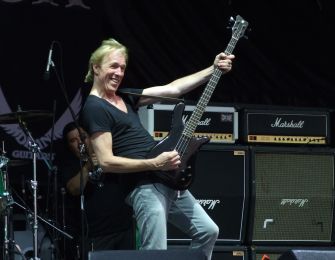
Francis Buchholz, the bassist whose steady, understated playing anchored the Scorpions through their most commercially successful era, died Thursday following a private battle with cancer. His family confirmed his death in a statement shared on social media. He was 71.
“He departed this world peacefully, surrounded by love,” the statement read. “Throughout his fight with cancer, we stayed by his side, facing every challenge as a family, exactly the way he taught us.” The family also thanked fans for their support, writing that while “the strings have gone silent,” Buchholz’s spirit endures through his music and the lives he touched.
Buchholz was a central figure in the Scorpions’ rise from a respected European hard-rock act to one of the defining arena bands of the 1980s. His bass work helped shape songs that remain staples of classic rock radio, including “Rock You Like a Hurricane,” “Wind of Change,” “No One Like You,” “Big City Nights,” and “Blackout.” In a genre often associated with excess, Buchholz’s approach was marked by restraint and precision, providing a firm foundation without overpowering the band’s melodic instincts.
Born Jan. 19, 1950, in Hanover, West Germany, Buchholz joined the Scorpions in the early 1970s, replacing the group’s original bassist. He made his recorded debut on the band’s second album, Fly to the Rainbow (1974), as the Scorpions were still searching for a broader international audience. Throughout the decade, the band steadily refined its sound, culminating in a breakthrough with Lovedrive (1979), the first album to feature lead guitarist Matthias Jabs and a clearer commercial direction.
That momentum carried into the 1980s, when the Scorpions became one of the era’s most successful hard-rock exports. Blackout (1982) reached the Top 10 in the United States and went on to achieve platinum status. It was followed by Love at First Sting (1984), which peaked at Number Six on the Billboard 200 and eventually sold more than three million copies in the U.S. alone. The band’s final studio album with Buchholz, Crazy World (1990), produced “Wind of Change,” a ballad that became a global anthem amid the collapse of the Eastern Bloc and introduced the Scorpions to an even wider audience.
Buchholz’s tenure coincided with several historic moments for the band. In 1988, the Scorpions became the first heavy-metal group to tour the Soviet Union, later returning to play the Moscow Music Peace Festival alongside acts such as Bon Jovi and Ozzy Osbourne. The international success of “Wind of Change” led to a meeting with then–Soviet leader Mikhail Gorbachev, underscoring the unusual cultural reach of the band during that period.
Beyond his role onstage, Buchholz was also involved in the business side of the Scorpions, helping navigate the group through decades of touring, recording, and international success. He left the band in the early 1990s, but his contributions remained woven into the sound and legacy of one of hard rock’s most enduring acts.