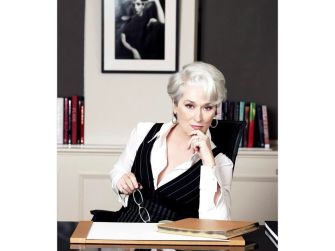
Meryl Streep is revisiting the way The Devil Wears Prada was positioned when it first premiered, arguing that the label it received at the time says as much about the industry as it does about the film itself.
In a recent appearance on The Late Show with Stephen Colbert, Streep said the film was initially categorized as a “chick flick,” a designation that, in her view, limited how seriously it was taken within the studio system. The term, widely used in the 2000s, often carried implications about audience scope and commercial value, which could affect both budget decisions and marketing strategy.
At the time of its release, The Devil Wears Prada, directed by David Frankel and adapted from Lauren Weisberger’s novel, was not positioned as a major prestige project. Despite this, it went on to become a significant commercial success and a lasting cultural reference point, particularly for its portrayal of workplace dynamics, ambition, and power within the fashion industry. Streep’s performance as Miranda Priestly earned her an Academy Award nomination and remains one of the most widely recognized roles of her career.
Looking back, Streep suggested that the “chick flick” label has aged poorly, especially in light of more recent films that have demonstrated the broad appeal of female-led narratives. She pointed to projects like Barbie and Mamma Mia! as examples that challenged earlier assumptions about what kinds of stories audiences are willing to support at scale.
Streep also noted that she has discussed these dynamics with Greta Gerwig, who directed Barbie. While Gerwig’s film ultimately became a major global hit, Streep indicated that even high-profile projects centered on women have historically faced questions about budget allocation and perceived risk compared to other large studio releases.
The contrast is particularly clear as The Devil Wears Prada 2 moves toward release. According to Streep, financial constraints were not a concern for the sequel in the way they were for the original. The follow-up film, set to arrive on May 1, will reunite Streep with Anne Hathaway and revisit the characters in a media landscape that has shifted significantly over the past two decades, particularly with the decline of traditional print publishing.
Beyond industry context, Streep also addressed the creative process behind Miranda Priestly, a character often assumed to be directly modeled after Anna Wintour. While Wintour’s influence on the source material is well documented, Streep said her performance drew more heavily from her experience working with film directors.
She cited Mike Nichols and Clint Eastwood as key references, describing Miranda’s tone as a combination of Nichols’ understated humor and Eastwood’s controlled, minimalistic authority. The result was a character defined less by overt intensity and more by precision and restraint, qualities that contributed to the film’s lasting impact.