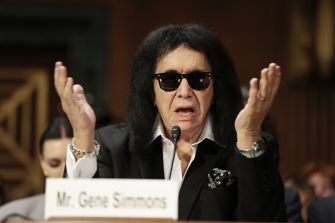
Gene Simmons is once again taking aim at the Rock & Roll Hall of Fame for inducting hip-hop artists, a long-running grievance from the Kiss co-founder that has resurfaced in a new podcast interview.
Speaking on the LegendsNLeaders podcast, Simmons argued that rap and hip-hop are fundamentally outside the scope of what the Hall should recognize. “It’s not my music,” he said. “I don’t come from the ghetto. It doesn’t speak my language.” From there, Simmons returned to a point he has made publicly for years: that the institution’s name is, in his view, the clearest boundary. “Hip-hop does not belong in the Rock & Roll Hall of Fame, nor does opera or symphony orchestras,” he said, suggesting that if genre lines don’t matter, then the Hall should be willing to extend the same logic to other forms. “How come the New York Philharmonic doesn’t get into the Rock & Roll Hall of Fame? Because it’s called the Rock & Roll Hall of Fame.”
Simmons also referenced a past exchange with Ice Cube, one of the most prominent artists to push back against the genre-policing argument. “Ice Cube and I had a back and forth,” Simmons said, adding that he respects the rapper while disagreeing with him. According to Simmons, Cube’s counterargument centered on an idea of rock and roll as more of an attitude than a strict sound, an “it’s the spirit of rock and roll” defense that has frequently been cited by hip-hop artists and Hall supporters alike. Simmons was unimpressed by that framing, pointing to the growing number of rap pioneers already enshrined. “So Ice Cube and Grandmaster Flash and all these guys are in the Rock & Roll Hall of Fame,” he said, before posing a rhetorical question meant to highlight what he sees as a one-way expansion. “I just want to know when Led Zeppelin’s going to be in the Hip-Hop Hall of Fame?”
In making his case, Simmons leaned on a description of rap as primarily verbal rather than melodic. “By and large, rap, hip-hop is a spoken-word art,” he said, acknowledging there can be musical elements but claiming the defining feature is the vocal delivery. In his view, labels matter because they describe different approaches (and once those approaches are treated as interchangeable, the meaning of the institution itself becomes muddled).
The argument is not new, but it remains a reliable flashpoint because it touches on a broader cultural question the Hall has faced for decades: whether “rock and roll” is a genre, an era, a lineage, or an umbrella term for popular music that carries a particular kind of impact. When the N.W.A was inducted in 2015, Ice Cube told Rolling Stone that rap is inseparable from the musical traditions that preceded it and that the Hall’s story is incomplete without it. He argued that hip-hop contains elements of rock and roll as well as soul, R&B, and blues, and that the throughline is less about guitar tones than about a disruptive cultural force. Simmons’ position, by contrast, treats the Hall as a genre museum that should protect its borders.
Simmons also revived another claim that tends to inflame music fans: that rock’s star-making machinery has collapsed and that the era of universally recognized icons is over. In a previous Rolling Stone interview from 2017, Simmons said, “There will not be another Beatles,” and challenged critics to name a post-1988 act with the same level of global reach and cultural dominance once commanded by rock’s biggest acts.