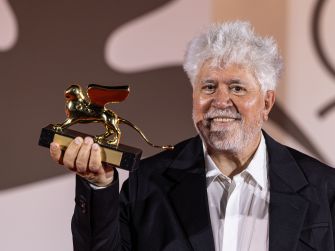
Pedro Almodóvar received another emotional reception at the Cannes Film Festival, as his latest feature, Bitter Christmas, earned a 6.5-minute standing ovation following its international premiere.
While not approaching the famously lengthy applause that greeted The Room Next Door in Venice, the response signaled strong appreciation from the Cannes audience for one of the festival’s most familiar returning auteurs. Almodóvar attended the screening alongside stars Bárbara Lennie and Leonardo Sbaraglia, as well as the wider ensemble cast, receiving a visibly emotional reaction inside the theater.
Addressing the audience after the screening, Almodóvar appeared briefly overwhelmed by the reception, telling attendees he struggled to find words. He reflected on his long history with Cannes, describing the festival’s audiences as consistently warm throughout his career and suggesting, in a moment that drew renewed applause, that he would deeply miss returning once the time comes when he no longer attends.
The reception adds another notable chapter to Almodóvar’s decades-long relationship with Cannes, where he remains one of the most established contemporary filmmakers to repeatedly compete at the festival without ever claiming its top prize.
Bitter Christmas marks his eighth film in competition, further cementing his unusually enduring presence on the Croisette. Over the years, Cannes has honored Almodóvar with major awards, including Best Director for All About My Mother in 1999 and Best Screenplay for Volver in 2006, with the latter also earning a collective Best Actress prize for its female ensemble. In 2019, Antonio Banderas won Best Actor for Pain and Glory. But despite that long history, the Palme d’Or has remained just out of reach.
Set across two timelines, Bitter Christmas follows Raúl, a film director played by Sbaraglia, who is struggling with creative paralysis in 2026. As he attempts to break through his writer’s block, he begins drawing inspiration from the lives of the people around him, including his longtime assistant, Monica, played by Aitana Sánchez-Gijón.
The screenplay Raúl develops becomes the second narrative thread of the film, shifting the story back to 2004 and centering on Elsa, an advertising director portrayed by Lennie, who is simultaneously working on her own script while processing the death of her mother. Elsa travels to Lanzarote with her friend Patricia, setting in motion a storyline that increasingly blurs the boundaries between lived reality and the fictional work being created inside the film itself.
As the story unfolds, the distinction between Raúl’s imagination and his personal life becomes less stable, a narrative device that aligns closely with themes Almodóvar has explored throughout his career, particularly around authorship, emotional memory, and the porous line between storytelling and lived experience.
The cast also includes Victoria Luengo, Patrick Criado, Milena Smit, Quim Gutiérrez, and Rossy de Palma, another longtime Almodóvar collaborator.
The film had already opened in Spain earlier this year to a positive reception before arriving at Cannes for its international debut. Produced by Agustín Almodóvar through El Deseo, the project has established international distribution support, with Sony Pictures Classics handling North America, Warner Bros. managing Spain and Mexico, and Curzon distributing in the United Kingdom and Ireland.