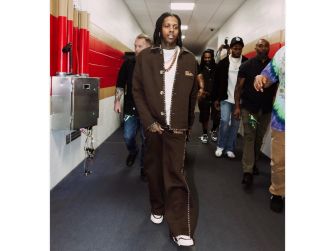
Federal prosecutors have significantly expanded their criminal case against rapper Lil Durk, filing a new superseding indictment that transforms the high-profile murder-for-hire prosecution into a broader racketeering case and introduces allegations tied to multiple violent incidents dating back several years.
The new indictment, returned by a federal grand jury and filed Thursday, adds charges of murder in aid of racketeering and conspiracy to commit stalking against the Chicago rapper, whose legal name is Durk Banks. Prosecutors now allege that Banks operated as a leader within a violent Chicago street gang and participated in or directed a series of criminal acts that stretched from 2019 through 2022.
The filing marks the most sweeping version of the government's case to date. While previous indictments primarily focused on an alleged murder-for-hire plot targeting rapper Quando Rondo in Los Angeles, the latest indictment expands the timeline and incorporates allegations involving a 2019 shooting in Atlanta and a 2022 homicide in Chicago.
According to prosecutors, Banks offered rewards and encouragement for acts of violence carried out by members of an alleged criminal enterprise. One of the newly added allegations centers on the January 2022 killing of a man described in court records as a rival gang member in Chicago. Prosecutors claim that after the killing, Banks allegedly brought $1 million in cash to a music studio and that one of his alleged associates later posted a photograph on social media displaying what authorities characterize as a reward connected to the crime.
The indictment also revisits an incident in Atlanta in February 2019. Prosecutors allege that Banks and others were involved in a shooting that stemmed from a dispute over the purchase of a stolen vehicle. According to the filing, the seller allegedly refused to issue a refund, leading to a confrontation in which gunfire was exchanged, and the victim was wounded. Banks has not been convicted of any crime related to the incident, and the allegations remain accusations brought by federal prosecutors.
The newly added racketeering count combines those allegations with the murder-for-hire case that has been at the center of the government's prosecution. Authorities claim the incidents demonstrate a pattern of criminal activity connected to an organized enterprise, a key requirement in racketeering cases.
Banks has pleaded not guilty to all previous charges and continues to deny the government's allegations. Prosecutors maintain that the rapper used intermediaries and coded communications to orchestrate an attack on Bowman, whom they claim Banks blamed for the 2020 death of his close friend and fellow Chicago rapper King Von. Bennett was killed during an altercation outside an Atlanta nightclub, a shooting that became one of the most widely discussed incidents in hip-hop in recent years.
The government alleges that after Bennett's death, Banks became determined to retaliate against Bowman. Prosecutors cite messages they claim were sent by Banks expressing anger over the killing and referencing his unwillingness to let the matter go unresolved. The indictment further alleges that Banks and several associates attempted to target Bowman in Georgia in May 2021, but the alleged plan failed when Bowman survived the encounter.
Authorities also point to an unreleased music video filmed in early 2021. According to prosecutors, the footage depicts Banks pursuing and shooting an actor who allegedly resembled Bowman. Investigators argue the video provides evidence of the rapper's state of mind and ongoing hostility toward the rival artist. Defense attorneys are expected to challenge the relevance and interpretation of that evidence.
The centerpiece of the case remains the August 2022 shooting near Los Angeles' Beverly Center. Federal prosecutors allege that a group of gunmen traveled across state lines to locate Bowman and ambushed him outside a gas station. Bowman survived the shooting, but his cousin, Saviay'a Robinson, was struck and killed. Prosecutors claim the attack was carried out on Banks' behalf as part of a murder-for-hire scheme.
Banks' legal team strongly criticized the new indictment, characterizing it as an attempt by prosecutors to strengthen what they view as a weak case shortly before trial. In a statement, attorneys Drew Findling, Marissa Goldberg, Brian Steel, and Christy O'Connor argued that the government is repackaging old allegations rather than presenting new evidence.
“This indictment is lipstick on a pig,” the attorneys said, contending that prosecutors are attempting to salvage a flawed prosecution by adding racketeering allegations and broadening the scope of the case. The defense maintains that Banks is innocent and argues that federal investigators have repeatedly altered their theories as witnesses changed their accounts.
The defense has previously challenged the government's evidence, arguing that prosecutors have failed to clearly establish when, where, and how an alleged bounty was offered. Attorneys have also questioned the reliability of cooperating witnesses, claiming some accounts have shifted over time and that key details have been removed or modified in successive versions of the indictment.
Banks, 33, has been in federal custody since his arrest in October 2024 and remains detained without bail. With the trial approaching, the newly expanded indictment raises the stakes considerably, exposing the rapper to additional charges that carry severe potential penalties if he is convicted.
For now, however, the allegations remain unproven. Prosecutors will bear the burden of demonstrating that the various incidents outlined in the indictment are connected as part of a racketeering enterprise, while Banks' legal team prepares to challenge both the government's evidence and its broader theory of the case.
The trial is expected to be one of the most closely watched criminal proceedings involving a major music artist in recent years, as federal prosecutors seek to tie together multiple alleged acts of violence into a single racketeering conspiracy and the defense continues to insist that the government has built its case on unreliable accusations rather than concrete proof.