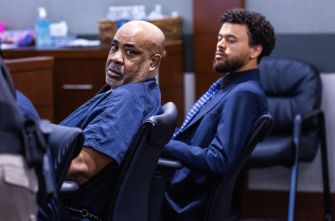
The man charged in connection with the 1996 killing of Tupac Shakur has lost a key pretrial motion, after a judge declined to suppress evidence obtained during a nighttime search of his Las Vegas home.
At a Tuesday hearing, the court rejected arguments from attorneys representing Duane “Keffe D” Davis, 62, who claimed the search warrant was secured through a distorted and misleading portrayal of their client. A courtroom source confirmed the ruling, which allows prosecutors to retain and use materials seized during the July 2023 search as the case moves toward trial.
Davis’ legal team had argued that investigators exaggerated his background in order to justify executing the warrant after dark. In filings, defense attorneys William Brown and Robert Draskovich contended that law enforcement depicted Davis as an armed and dangerous narcotics trafficker who might trigger a violent standoff, thereby creating urgency for a nighttime operation. That portrayal, they said, “bore little resemblance to reality.”
According to the defense, Davis was a retired grandfather and cancer survivor living quietly with his wife in a suburban Las Vegas neighborhood at the time of the search. They noted that when a detective initially approached him during daylight hours, Davis “cooperated politely” and merely requested the presence of an attorney before answering questions. His prior drug convictions, they argued, were decades old, and a subsequent gun arrest did not result in a conviction. After leaving the drug trade in 2008, Davis reportedly worked for years as an oil refinery inspector.
Police, however, maintained that executing the search at night was a matter of officer and community safety. In the warrant application, Las Vegas Metropolitan Police Department Detective Clifford Mogg wrote that “the cover of darkness” would allow officers to secure the residence more effectively and reduce exposure should occupants attempt to barricade themselves. The defense countered that neighbors were more likely to be home at night, undercutting the stated safety rationale.
Davis has pleaded not guilty to a single count of murder and is being held without bail at the Clark County Detention Center. Prosecutors allege he orchestrated the drive-by shooting that killed Shakur and supplied the .40-caliber Glock used in the attack, which also wounded Suge Knight, then co-founder of Death Row Records. Authorities say the shooting was retaliation following an altercation between Shakur and Orlando Anderson inside a Las Vegas casino hours earlier on Sept. 6, 1996.
Central to the prosecution’s case are Davis’ own words. In a 2019 memoir, he described his involvement with the South Side Crips and recounted details of the night of the shooting. During a 2008 interview with law enforcement, he claimed that Sean Combs had offered $1 million to have Knight and Shakur killed amid an escalating East Coast–West Coast feud, an allegation Combs has repeatedly denied. Davis also stated that an associate supplied the gun that was later passed into the back seat of a rented Cadillac, where Anderson allegedly fired the fatal shots.
Prosecutors argue these admissions are powerful corroborative evidence. The defense, meanwhile, characterizes them as opportunistic storytelling, crafted for profit and notoriety. In court filings, Davis’ lawyers likened the public fascination with Shakur’s death to the assassination of John F. Kennedy, suggesting that the enduring mythology surrounding the case creates incentives for false confessions and embellished accounts.
Anderson denied involvement in the shooting before he was killed in 1998. The alleged murder weapon has never been recovered.
With the motion to suppress denied and previous attempts to dismiss the charges unsuccessful, the case now advances toward trial. After multiple delays, jury proceedings are currently scheduled to begin Aug. 10, marking the most consequential legal reckoning yet in a case that has lingered in cultural memory for nearly three decades.