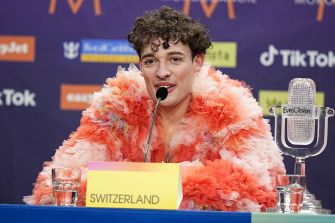
Nemo, the Swiss artist who won the Eurovision Song Contest in 2024, has announced plans to return their winner’s trophy in protest of Israel’s participation in the 2026 competition. The decision adds to growing controversy surrounding the European Broadcasting Union’s (EBU) handling of the contest amid the ongoing war in Gaza.
In a statement shared on Instagram on Thursday, Nemo said the decision was rooted in a perceived contradiction between Eurovision’s stated values and the EBU’s actions. “Eurovision says it stands for unity, inclusion, and dignity for all,” they wrote. “Those values made this contest meaningful to me. But Israel’s participation, during what the UN’s Independent International Commission of Inquiry has concluded to be a genocide, shows a clear conflict between those ideals and the decisions made by the EBU.”
Nemo said they would send the trophy back to EBU headquarters in Geneva, adding, “If the values we celebrate onstage aren’t lived offstage, then even the most beautiful songs lose their meaning.”
The announcement follows last week’s decision by the EBU not to hold a vote on whether Israel should be barred from the 2026 contest. Several member broadcasters had urged the organization to reconsider Israel’s eligibility due to the humanitarian crisis in Gaza, but the EBU instead opted to move forward with the competition while introducing what it described as “additional safeguards” aimed at reinforcing neutrality and transparency.
Those safeguards are intended to limit the influence of governments and third parties on voting outcomes, following accusations from some broadcasters that Israel engaged in coordinated efforts to support its 2025 contestant, Yuval Raphael. The EBU has denied that the integrity of the contest was compromised.
The decision not to vote triggered immediate backlash. Broadcasters in Ireland, Spain, the Netherlands, and Slovenia announced they would boycott the 2026 contest in response. Iceland later joined the group. Ireland’s public broadcaster, RTÉ, said in a statement that participation was “unconscionable given the appalling loss of lives in Gaza and the humanitarian crisis there, which continues to put the lives of so many civilians at risk.”
Israel’s leadership welcomed the EBU’s ruling. President Isaac Herzog described the decision as “an appreciated gesture of solidarity, brotherhood, and cooperation,” calling it a rejection of efforts to “silence Israel and spread hatred.” Advocacy organizations opposed to cultural boycotts of Israel also praised the outcome, with several prominent figures arguing that artists should not be excluded based on their nationality.
The EBU has not publicly responded to Nemo’s decision to return the trophy. A representative did not immediately reply to Rolling Stone’s request for comment.
Nemo won Eurovision 2024 with the song “The Code,” becoming the first openly nonbinary artist to win the competition. Their victory was widely celebrated as a milestone for LGBTQ+ representation within the contest, which has long positioned itself as a platform for diversity and inclusivity.
By returning the trophy, Nemo becomes one of the most high-profile figures to take a symbolic stand against the EBU’s current position. While the gesture carries no formal implications for the contest itself, it underscores the widening divide among artists, broadcasters, and audiences over Eurovision’s role during a period of intense global conflict.
The Eurovision Song Contest, founded in 1956, remains one of the world’s largest live television events, drawing an estimated 166 million viewers globally last year. The 2026 edition is scheduled to take place in May in Vienna, Austria, though participation from several countries now remains uncertain as political pressure continues to mount.