For half a century, what many Elvis Presley devotees considered the ultimate lost treasure remained sealed away in a Kansas salt mine: ten professionally filmed concerts from the early 1970s, captured at the height of Presley’s powers as a live performer. Preserved by the same geological conditions that protect nuclear waste and rare documents, the footage existed largely as a rumor in collector circles but was effectively inaccessible to the public.
That changed when Baz Luhrmann began preparing his 2022 biopic Elvis. As part of his deal with Warner Bros., Luhrmann requested access to all 59 hours of concert and behind-the-scenes footage the studio owned, originally shot for Elvis: That’s the Way It Is (1970) and Elvis on Tour (1972). What he found exceeded even his expectations. Alongside electrifying performances filmed from multiple angles were candid backstage moments and extended interviews with Presley, an artist famously wary of the press. “This wasn’t just concert footage,” Luhrmann says. “It was Elvis unguarded. Vulnerable. Reflective. We couldn’t let it go back into the salt mines.”
The result is EPiC: Elvis Presley in Concert, opening in IMAX on Feb. 20 and expanding to theaters nationwide Feb. 27. Rather than functioning as a conventional music documentary, the film operates as something closer to an experiential collage. Luhrmann describes it as a “tone poem”, a non-linear meditation in which Presley narrates his own life through archival audio, interviews, and song.
Technically, assembling the film posed enormous challenges. Despite the salt mine’s protective environment, much of the footage showed signs of chemical decay. “When we opened the reels, there was a vinegar smell,” Luhrmann recalls. “That’s the smell of film breaking down.” Some reels were perilously close to disintegration.
While the visuals could be painstakingly restored through digital transfer, many of the concert reels lacked synchronized sound. Fortunately, RCA had preserved multitrack audio recordings of every performance. The filmmakers meticulously aligned these tapes with the footage in a process that took months. During the audio search, they uncovered a previously unheard 45-minute interview conducted in 1972 with the camera turned off. Presley, exhausted and unusually candid, speaks about fame, regret, and the compromises of his career.
That discovery shaped the film’s core idea: to allow Presley to speak for himself. “So much of Elvis’ story has been filtered through other people,” Luhrmann says. “This was a chance to let him tell it.”
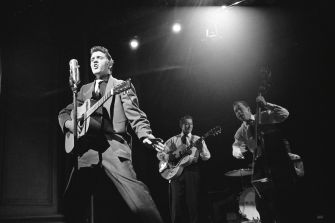
EPiC opens with a soaring rendition of “An American Trilogy” before ricocheting backward through fragments of Presley’s career, such as early television appearances, grainy fan-shot concert footage, and clips from the Hollywood films that dominated his 1960s output. In one quietly devastating moment, Presley reflects on his time making formulaic studio movies. “Hollywood’s image of me was wrong,” he says. “I knew it, and I couldn’t say anything about it.”
The film’s spine remains the concerts of 1970 and 1972, showcasing performances of “Suspicious Minds,” “Bridge Over Troubled Water,” “Burning Love,” “In the Ghetto,” and “How Great Thou Art.” Editor Jonathan Redmond initially worried that the constant shifts between formats, Super 8, 16mm, 35mm, varying aspect ratios, would feel disorienting. Ultimately, the team embraced the fragmentation. “We didn’t want a smooth, linear experience,” Redmond says. “That wouldn’t have felt honest.”
To finalize the restoration, the footage was sent to Peter Jackson’s team in New Zealand, whose work on The Beatles: Get Back set a new benchmark for archival filmmaking. The goal was clarity without sterilization. “You can restore something so much that it stops looking like film,” Redmond explains. “They understand how to clean it without erasing its soul.”
Notably absent is footage from Presley’s final years, including his 1977 concert special. Luhrmann made a conscious decision not to revisit that material. “We didn’t want it to end with decline,” he says. “We wanted to leave him in motion.”
The film closes by noting that Presley performed more than 1,100 concerts between 1969 and 1977, sometimes multiple shows in a single day. Luhrmann frames this relentless pace not as triumph, but as compulsion. “The stage became the only place where he felt love,” he says. “He became addicted to performing.”
Though Luhrmann is currently developing a film about Joan of Arc, he admits he may not be finished with Elvis. A full 1972 concert filmed at Hampton Coliseum remains unseen in its entirety. For now, EPiC stands as something rare: a music film that resists mythmaking in favor of intimacy, allowing one of the most overexposed figures in pop culture to feel, once again, startlingly human.